
How to organize a Car-Free Day in 10 steps — in your city or your company
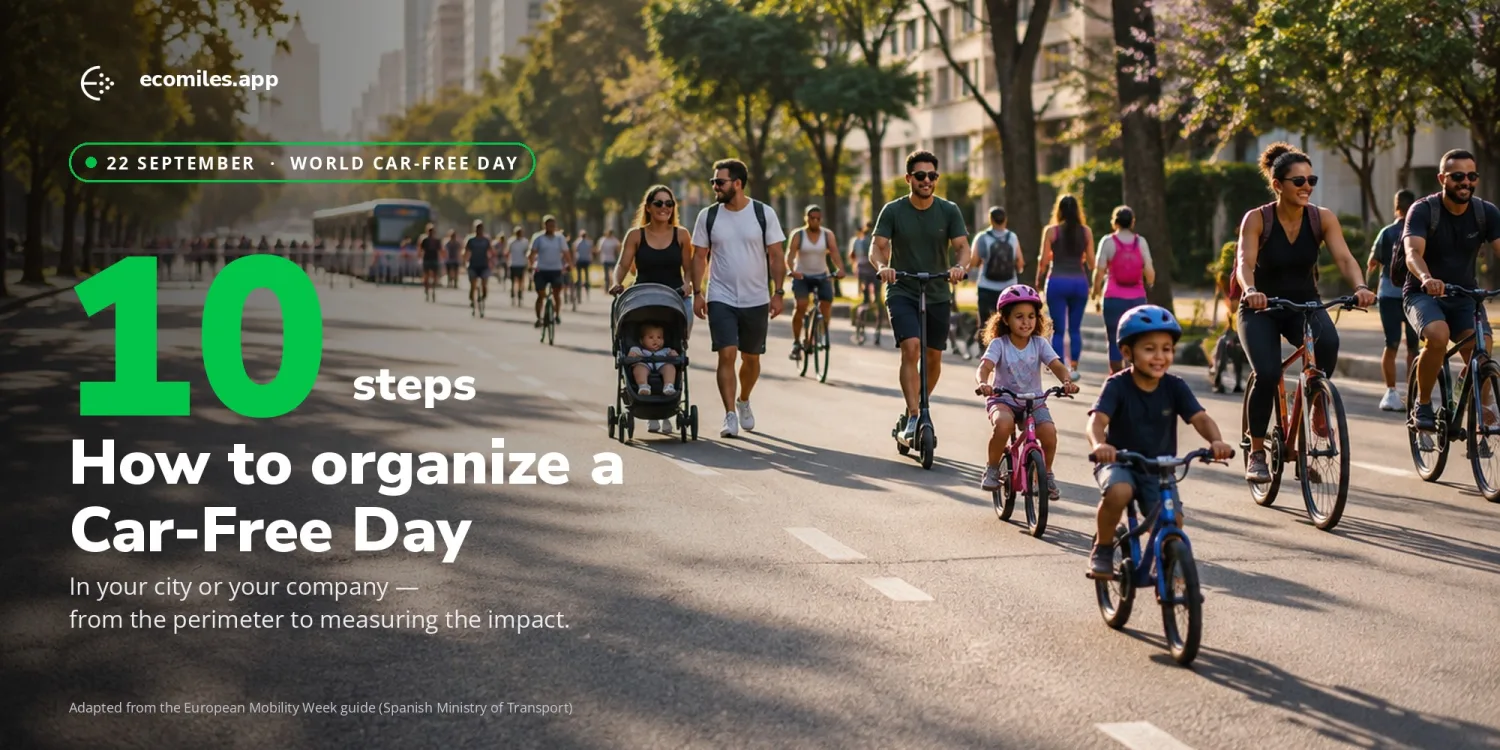
Every 22 September, thousands of cities across Europe and around the world close their streets to motorised traffic and open them to people. It is World Car-Free Day, the highlight of European Mobility Week — and no wonder that, once they have tried it, people want more car-free days throughout the year.
European Mobility Week publishes a one-page guide, “How to organise a Car-Free Day in 10 steps”, written for municipalities. Here we adapt each step for two audiences we work with every day: cities planning their own day, and companies that want the corporate version — a day (or a week) when the team leaves the car at home and the organisation measures what that is worth in CO₂e.
1. Define the area
In the city: the event can cover the whole municipality or a specific area. If there is more than one area, connect them with pedestrian routes. Consider the type of area (residential, commercial, offices), accessibility and nearby parking, and give drivers clear information.
In the company: the “perimeter” is your operation — one site, a campus, every branch. Start with the address where car commuting is highest and real alternatives exist.
2. Decide when
A weekday maximises the reduction in emissions, noise and fuel, and shows people there are other options for their daily commute. Repeating the experience one Sunday a month also works. For companies, 22 September is the obvious date — but a monthly “Car-Free Week” usually engages more than a one-off event.
3. Communicate clearly
Use every channel available and never take people by surprise: clear communication reduces complaints and infringements. Explain the benefits of sustainable mobility and what changes on the day. In a company, that means announcing early, explaining the exceptions and saying what people gain by taking part.
4. Involve organisations
The more the better: cycling groups, schools, businesses, residents’ associations, youth councils, transport operators. Pay special attention to local retailers. In a company, the natural partners are HR, Sustainability, Facilities and Internal Comms — plus the nearest bike-share operator.
5. Regulate access
The defined areas must be closed to traffic with barriers and access must be monitored, in cooperation with the traffic authority, the police and other local bodies. The corporate version is simpler: close (or shrink) the car park for the day and turn the spaces into a meeting point, bike parking or a social area.
6. Provide alternatives to the car
More frequent public transport, accessible to people with reduced mobility, with special fares or free tickets, combined with park-and-ride. Shared bikes and micromobility are great alternatives — cargo bikes included. In a company: a stronger transit allowance, organised carpooling between colleagues, a shuttle from the nearest station and, of course, a reward for every car-free trip — which is exactly what the Ecomiles app does, turning kilometres walked, cycled, on public transport or carpooled into balance on a card.
7. Take emergency services into account
Guarantee exceptions for healthcare professionals, people with disabilities, emergency services and urgent repairs. Any other exception should go through the responsible department — and be kept to a minimum. In a company, define the exceptions in advance and in writing, so nobody feels penalised.
8. Think about parking
Some people will need to park. The parking area must be connected by public transport, shared bikes or scooters and pedestrian and cycling infrastructure; shuttles are worth considering. Residents should clear the streets the day before.
9. Measure and show the impact
Collect data on fuel consumption, emissions, health impacts, noise levels, traffic and costs to demonstrate the positive effects of the Car-Free Day. This is the step that separates a nice event from a policy that lasts — and it is where Ecomiles comes in: every trip logged in the app is GPS-verified, goes through Emília’s anti-fraud analysis and becomes tCO₂e avoided with an auditable trail, ready for the Scope 3.7 (employee commuting) inventory, GHG Protocol, CDP and CSRD. Cities can use the same data to compare the Car-Free Day with an ordinary day.
10. Visualise a car-free future
The Car-Free Day is the ideal occasion to show what a street or neighbourhood would look like without cars — and to test permanent solutions. Many municipalities have already taken that step. In a company, the equivalent is turning the pilot into an ongoing programme, with modal-shift targets and rewards all year round.
Want to start on 22 September?
If your company wants to run its Car-Free Day (or Week) with auditable measurement and rewards for the team, talk to us. If you are with a municipality or a collective, the original European Mobility Week guide is at mobilityweek.eu. And if you are in Europe, the Grand Prix Sustainable Commute 2026 runs during Mobility Week.
Source: “Cómo organizar un Día Sin Coches en 10 pasos”, European Mobility Week 2026, Spanish Ministry of Transport and Sustainable Mobility, in partnership with the European Commission. Adaptation and commentary: Ecomiles.
Want this at your company?
Decarbonization with auditable primary data and engagement employees actually enjoy.
Book a demo →